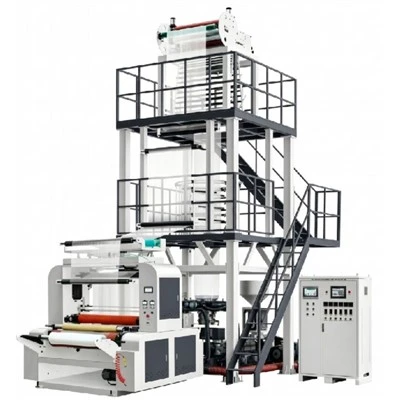
If you’ve spent any time working with mono layer film blowing machines, you know that the screw isn’t just a rotating part—it’s the heart of your process, pushing melted plastic through the die to get the film thickness, clarity, and consistency your products need. Over time, though, that screw wears down, and suddenly you’re dealing with uneven output, thicker than expected scrap, and unexpected downtime that eats into your bottom line. As a supplier of mono layer film blowing machines, I get this firsthand: we work with dozens of extrusion plant managers every month, and one of the most common questions they ask is, “What’s the real wear rate I can expect from my machine’s screw?” The answer isn’t a one-size number, but it’s rooted in hard data, material choices, and how you run your line. Let me break this down like I do with our clients, no industry jargon that doesn’t mean anything for your operation. Mono Layer Film Blowing Machine
First, let’s talk about what actually causes screw wear in a mono layer film blowing machine. Most people think wear is just friction from plastic melting and sliding over the metal, but it’s way more specific than that. For most mono layer lines, we work with polyethylene (PE) whether it’s low density (LDPE) or linear low density (LLDPE), but even that comes in different grades. LLDPE, for example, has higher abrasion resistance than LDPE, but it also has more co-monomers that can create small, hard particles when processed at high temperatures. Then there’s regrind material—about 60% of our clients use some post-industrial or post-consumer regrind in their mix to cut costs, and that’s a huge driver of wear. Regrind often has tiny metal shavings from trimming processes, or even small pieces of rock and dirt that make their way into scrap bales. Those hard particles act like sandpaper inside the barrel, scraping against the screw’s flights and surface as it rotates at 100 to 200 RPM (standard for most mono layer lines). Add to that process variables: if you run your barrel temperatures too high, the melted plastic can degrade, releasing corrosive gases that etch the screw’s metal from the inside. Or if you underfeed the hopper, you run the screw dry for short periods, which generates extreme heat and wears the surface faster than normal.
Now, to the core question: wear rate, measured in millimeters of material removed from the screw’s outer diameter per thousand hours of operation. For a standard carbon steel screw, the kind we put on our entry-level mono layer film blowing machines for small production runs, the average wear rate is between 0.12 mm and 0.18 mm per 1,000 operating hours. I’ve seen this hold up with clients who run 8 hours a day, 5 days a week making LDPE shrink film for food packaging—after 3,000 hours, that’s about 0.45 mm of wear, and by the time it hits 1.0 mm, they start to notice output inconsistencies. But if you’re using a harder material, like the nitrided steel we offer for mid-range machines, that number drops to 0.06 mm to 0.10 mm per 1,000 hours. Nitriding is a process where we infuse nitrogen into the screw’s surface, creating a super-hard outer layer that resists abrasion way better. Then there’s tungsten carbide coated screws for high-output or regrind-heavy lines, which have a wear rate as low as 0.02 mm to 0.05 mm per 1,000 hours. That’s a big difference, and it’s why we always match the screw material to what our clients are producing.
Wait, but let’s make this concrete with real examples from our recent projects. Last quarter, we installed a mono layer line for a flexible packaging plant in the Midwest that runs 100% virgin LDPE for produce bags, 24/7. They’re on their 18th month of operation, logging roughly 12,000 hours so far. When we did a routine maintenance check last week, their nitrided screw had worn 0.78 mm—right in line with the 0.065 mm per 1,000 hour wear rate we’d calculated. Contrast that with another client, a small converter in Texas who runs 50/50 LDPE regrind on their entry-level carbon steel screw, operating 12 hours a day, 6 days a week. After just 8 months, or about 7,800 hours, their screw had already worn 0.95 mm, which translates to a wear rate of 0.122 mm per 1,000 hours—actually a little lower than our average, but still high enough that they’re planning to replace it in the next 3 months. That’s the thing: regrind cuts material costs, but it almost always accelerates wear. We tell clients that if regrind makes up more than 30% of their resin mix, upgrading to a nitrided or carbide coated screw is worth the extra 10% to 15% upfront cost, because it will extend the screw’s life by 2 to 3 times.
I also want to address the myths we hear all the time from new operators. Some people say you’ll need to replace your screw every year, others swear theirs lasted 10 years. Neither is wrong—because it all depends on your process. If you run a mono layer line for 8,000 hours a year with virgin resin and a nitrided screw, you could easily get 8 to 10 years of use. If you run 12,000 hours a year with 50% regrind on a carbon steel screw, you might only get 1 to 2 years before it’s too worn to produce consistent film. The key indicators that it’s time to service or replace the screw aren’t just time-based: look for fluctuations in output pressure (if your meter jumps 10 to 15 psi over a week with no other changes), uneven film thickness variation (more than ±5% from the desired gauge), or increased melt temperature inconsistency. Those are the signs, not a set timeline.
As a supplier, we don’t just sell machines and parts—we help our clients extend the life of their equipment, because we know that downtime is their biggest cost. That’s why we include wear analysis as a free service for all our customers: when you schedule a maintenance check, we measure your screw’s wear rate against your operation’s specific conditions, and give you a timeline for when you should plan to replace it, or suggest adjustments to your resin mix or process parameters to slow wear. For example, last month we worked with a client who was seeing 0.22 mm of wear per 1,000 hours—double the average. We found they were running their barrel temperatures 20°F higher than needed for their LLDPE resin, causing the plastic to degrade and corrode the screw’s surface. After they adjusted the temperatures back to the recommended range, their wear rate dropped to 0.08 mm per 1,000 hours, and their film clarity improved too.
Another point that’s often overlooked: mono layer film blowing machine screws come in different L/D ratios (length to diameter), and that affects wear as well. Standard L/D ratios for mono layer lines are 24:1, 30:1, and 32:1. A longer screw (higher L/D) has more surface area exposed to the barrel, so it will wear slightly faster than a shorter one, all else equal. But longer screws also provide better melting and mixing, so the tradeoff is worth it for most clients—especially if they’re producing higher quality film. We make sure to explain that tradeoff upfront, so you don’t end up with a screw that’s perfect for wear but bad for your product’s quality.
Now, let’s talk about what happens when you ignore screw wear. If you run a screw that’s 1.5 mm or more worn, you’ll start getting melt fractures in your film—those small, irregular lines that ruin finished rolls and lead to 10% to 20% more scrap. You’ll also use more energy: a worn screw needs more torque to push the plastic through, so your motor works harder, adding 5% to 10% to your monthly electricity bill. For a line that runs 800 hours a month, that’s an extra $150 to $300 a month just from unnecessary energy use. Multiply that by 12 months, and it’s enough to cover a complete screw overhaul, or even a small portion of a new machine. That’s why it’s not just a maintenance cost—it’s a bottom line impact that’s easy to miss until it’s too late.
I’ve had clients come to me after 6 months of dealing with excessive scrap and high energy bills, only to find out their screw was way more worn than they thought. Last year, a client in Ohio told us their scrap rate was 12% higher than the industry average, and they couldn’t figure out why. When we inspected their screw, it had 1.8 mm of wear—they’d been running it for 14,000 hours, and since they used regrind, that wear rate was actually 0.129 mm per 1,000 hours, which was on track, but they didn’t know to check for signs of wear before it hit that point. After we replaced the screw with a nitrided one and adjusted their regrind processing steps, their scrap rate dropped to 4% in 3 months, saving them over $40,000 in scrap costs that year. That’s the kind of return we love to see.
So, to circle back to the original question: there’s no universal wear rate for a mono layer film blowing machine’s screw, but the data we’ve collected from hundreds of our machines gives us a clear baseline. For standard carbon steel screws in virgin resin lines: 0.10 to 0.18 mm per 1,000 hours. For nitrided steel: 0.05 to 0.10 mm per 1,000 hours. For tungsten carbide coated: 0.02 to 0.05 mm per 1,000 hours. Your actual rate will shift based on regrind use, resin type, run time, process temperatures, and maintenance habits. If you’re not sure what your screw’s wear rate is, or if you’re planning to upgrade your mono layer line and want a screw that’s tailored to your needs, we’re here to help. We don’t just sell equipment—we work with you to optimize your process, reduce downtime, and keep your film quality consistent. If you’re interested in learning more, getting a wear analysis for your current machine, or discussing a new mono layer film blowing machine that’s built to fit your specific production needs, reach out to our team to start the conversation. We’re not just suppliers—we’re partners in your success.
Bag Making Machine References
- Engineering Guidelines for Extrusion Screw Wear, Society of Plastics Engineers (SPE), 2021
- "Abrasion Resistance of Extrusion Screws for Polyethylene Resins", Journal of Plastic Film & Sheeting, Vol. 37, No. 2, 2020
- Maintenance Best Practices for Film Blowing Lines, National Association for Flexible Packaging (NAFP), 2022
- Tungsten Carbide Coating Performance in High-Regrind Extrusion Processes, International Extrusion Technology Association (IETA), 2019
Ruian Jianhao Precision Machinery Co., Ltd.
As one of the most professional mono layer film blowing machine manufacturers and suppliers in China, we’re featured by quality products and good price. Please rest assured to wholesale durable mono layer film blowing machine for sale here from our factory. Welcome to contact us for customized service and quotation.
Address: No. 8, Jianshe Road, Beiyu Village, Shangwang Street, Ruian City, Wenzhou City, Zhejiang Province
E-mail: 1832333027@qq.com
WebSite: https://www.jianhaomachinery.com/
