Let’s get real for a second – if you work in construction, you know that film faced formwork isn’t just a pile of wood and plastic. It’s the backbone of any concrete structure, the difference between a smooth, consistent finish and a project that’s going to cost you extra time, money, and headaches down the line. As a film faced formwork supplier who’s been in this game for 12 years, I’ve seen every trick in the book: cheap knockoffs that warp after one pour, film that peels off after a single rain, and formwork that’s so flimsy it can’t hold concrete pressure without sagging. Today, I’m pulling back the curtain on how to actually evaluate the quality of these panels – no sales fluff, no confusing jargon, just the real factors that separate a great formwork from a waste of your budget. Film Faced Formwork
First, let’s start with the foundation of every film faced formwork panel: the core. Most people don’t realize that the core is where 70% of a panel’s durability lives. I’ve had clients come to me saying they bought “marine-grade” panels for half my price, only to find out the core was made from mixed softwood, pine, and even some low-quality particleboard that couldn’t hold moisture. The truth is, the best cores are made from solid, graded hardwood veneers – usually birch, poplar, or eucalyptus, depending on the region, but they have to be kiln-dried evenly to a moisture content between 8% and 12%. That’s non-negotiable. If the core has uneven moisture, it will expand and contract at different rates when it’s exposed to concrete (which is about 50% water) and the elements, leading to warping, cupping, or splitting after just a few uses. I test every core we send out by checking its moisture content in three different spots – edge, middle, and end – because even one spot that’s off by 2% can ruin the whole panel’s lifespan. I once had a client skip this step and use panels with a core moisture of 18%; after three concrete pours, they had to replace 40% of their formwork. That’s a cost that could’ve been avoided by just a quick core check.
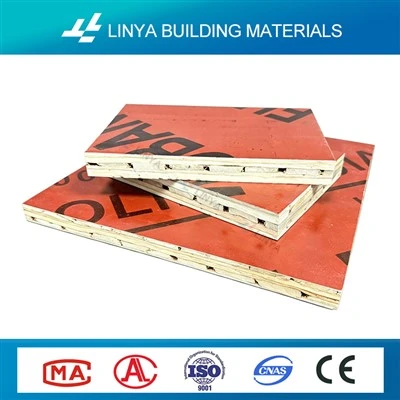
Next up, the film surface – this is the part that you see, and what gives your concrete that perfect finish. The film isn’t just a thin plastic layer glued to the face; it’s a high-density polymer (usually phenolic resin or melamine) that needs to be bonded to the core with extreme pressure and precision. Cheap panels use a thin film – sometimes just 0.2mm thick – that peels off after two or three uses, especially if they’re exposed to UV rays or abrasive concrete release agents. The good stuff? A film that’s at least 0.4mm thick, with a uniform, smooth surface that has no bubbles, scratches, or uneven spots before it even hits the core. When evaluating the film, do the “thumb test” – gently rub your thumb back and forth across the surface. If you feel any rough spots or tiny bubbles under the film, that’s a sign of bad lamination. Also, scratch it lightly with a nail (I know, it sounds harsh, but it’s a quick test) – if the film comes off in a piece, that’s not a film faced panel, that’s a cheap sticker. The best films are resistant to both scratches and UV radiation, so they can be reused 10 to 15 times, compared to 2 to 5 times for low-quality ones. I had a project manager tell me last month that his team used our panels for a bridge pour, and the film still looked like new after 12 uses – that’s the kind of quality we stand for, and it all starts with that film lamination process.
Then there’s the bonding between the core and the film. This is where a lot of suppliers cut corners. They use low-grade adhesives that break down when exposed to water or concrete’s alkaline pH (concrete is naturally very basic, with a pH around 12-13). If the adhesive is weak, the film will separate from the core mid-pour, leaving you with concrete stuck to both the panel and your structure. To test this, take a spare panel (or ask your supplier for a sample) and submerge it in water for 72 hours. After that time, check the edges and the corner joints. If the film is peeling or the core is swelling, that’s bad adhesive. The right adhesive for film faced formwork is a waterproof, phenolic-based resin that can withstand not just water, but also the chemicals in concrete. We test every batch of adhesive we use by running this exact water submersion test – any sample that fails gets tossed, no exceptions. I’ve seen other suppliers skip this test to save time, and they end up with 100+ panels ruined on a single project. Don’t let that be you.
Pressure resistance is another critical factor that’s often overlooked. Formwork has to hold in liquid concrete, which exerts a lot of pressure – especially for vertical walls or deep beams. If your panels can’t handle that pressure, you get blowouts: concrete seeping out between panels, uneven surfaces, and even safety hazards for your crew. The best film faced formwork has a high density, usually around 650-700 kg/m³. To test density, check the panel’s weight – a 18mm x 1220mm x 2440mm panel should weigh around 35-40 kg. If it’s lighter than that, the core is probably low-density softwood or even partially made from recycled materials, which can’t handle pressure. You can also do a simple bend test: take a corner of the panel and apply gentle pressure down. If it flexes more than an inch or two, it’s too flimsy. We also rate our panels for specific pressure levels – our standard panels handle up to 60 kN/m², and our heavy-duty panels for large projects handle up to 80 kN/m², which is perfect for high walls or deep foundations. I always advise clients to ask their supplier for pressure ratings, not just “how good the panels are” – numbers don’t lie.
Durability over multiple uses is where you really tell the difference between a budget panel and a quality one. A lot of suppliers will tell you their panels can be reused 10 times, but that’s only if they’re high-quality. Cheap panels will show signs of wear after 2 or 3 uses: warped edges, peeling film, scuffed surfaces that make concrete look rough. To evaluate this, ask for a sample of a panel that’s already been used 5 times (not a brand new one). Check the edges for any signs of core exposure, the film for scratches, and the overall flatness. If the sample is still within 1mm of being perfectly flat, that’s a good sign. We have clients who rent out our panels for large projects, and they get 15-20 uses out of them before they’re retired – that’s a huge return on investment compared to buying cheap panels that you have to replace every few pours. I once worked on a high-rise project where the contractor used our panels for 18 floors, and they still looked good enough to sell as reconditioned panels for another job. That’s the kind of longevity that matters.
Edge treatment is another detail that makes or breaks a panel. The edges of film faced panels are the most vulnerable part – they’re exposed to moisture, concrete, and impact, so if they’re not sealed properly, the core will swell and split. The best panels have their edges sealed with a waterproof paint or resin that matches the film, creating a barrier between the core and the outside elements. Some suppliers skip this step, leaving the edges bare, which is a death sentence for the panel’s lifespan. You can spot bad edge treatment easily: run your finger along the edge. If it feels rough, or if you can see the individual wood fibers, it’s not sealed. A properly sealed edge will feel smooth, like the film surface, and won’t absorb water when you dab a little drop on it. We invest extra time in sealing every edge of our panels, even though it adds a few cents to the cost – but that’s what our clients pay for: panels that don’t fall apart after one rain.
Finally, certification and consistency. In the construction industry, certifications like EN 13352 (the European standard for film faced formwork) or ASTM D5000 (the US standard) are there for a reason. They mean the panel has been tested for all the factors I just mentioned: core quality, film thickness, pressure resistance, durability. If a supplier can’t provide you with a certificate, that’s a red flag. Also, consistency is key – you don’t want one panel in a shipment that’s good, and the next one that’s completely different. We do batch testing for every shipment we send out: we pull 5 random panels from each batch of 100, test their moisture content, density, film thickness, and pressure resistance, and include a copy of the test results with the shipment. That way, our clients know exactly what they’re getting, every single time. I’ve had clients tell me they bought from a supplier that had great reviews, but each shipment had different quality panels – one batch was perfect, the next was full of warped panels. Consistency is non-negotiable, and that’s what sets us apart.
At the end of the day, evaluating film faced formwork isn’t rocket science – it’s about paying attention to the details that cheap suppliers cut corners on. The core, the film, the bonding, pressure resistance, durability, edge treatment, and certification: these are the factors that will save you time, money, and headaches on every project. I’ve seen too many projects go over budget because they tried to save a few bucks on formwork – don’t be that person. Invest in quality panels, because they’re the foundation of a great structure.
If you’re working on a construction project and you need reliable, high-quality film faced formwork that meets all these standards, reach out to our team for a consultation. We can provide sample panels, test results, and tailored solutions for your project’s specific needs, whether it’s a small residential build or a large commercial infrastructure project. Let’s talk about how we can help your project run smoothly, without the hassle of low-quality formwork.
Bamboo Formwork References
EN 13352:2018, Formwork – Prefabricated formwork elements made of wood-based materials – Specifications and test methods
ASTM D5000-19, Standard Specification for Phenolic Film-Faced Wood Panels for Concrete Forming
Construction Industry Institute (CII), Formwork Best Practices Report, 2021
Shenzhen Linya Building Materials Co., Ltd.
We are one of the most professional film faced formwork manufacturers and suppliers in China, also support customized service. Welcome to buy bulk high quality film faced formwork in stock here from our factory. If you have any enquiry about free sample, please feel free to email us.
Address: Bantian International Center, No.5 Huancheng South Road, Ma’antang Community, Bantian Street, Longgang District, Shenzhen
E-mail: linya@formworksteelprop.com
WebSite: https://www.linyabuildingmaterials.com/
